Clarion Guild of Handicraft (Liverpool Guild) rose bowl
Over the Christmas period I have enjoyed a bit of research on the Clarion Guild of Handicraft. The discovery of a copper bowl made by the Guild spurred me on to learn a bit more about them and tell a little bit of their story.
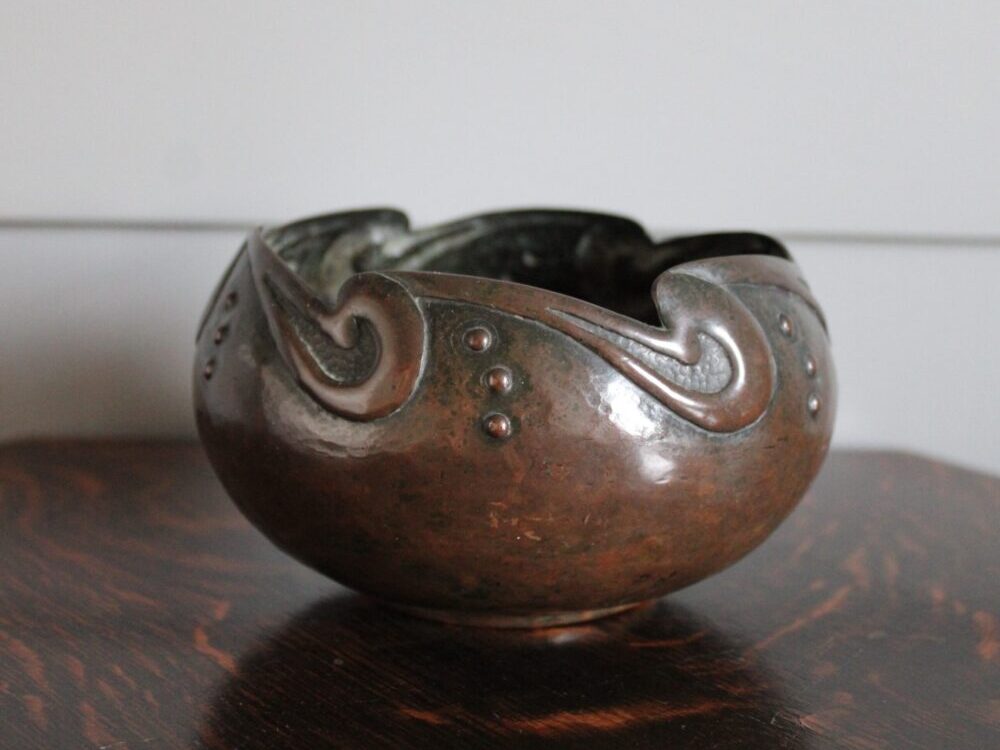
Copper bowl made by Harry Myddleton-Worrall, circa 1904.
The story really begins with the Clarion newspaper which started life in 1891. It was a weekly newspaper published by the socialist campaigner, journalist and author, Robart Blatchford. It was a socialist newspaper with a national focus. There were quite a number of associated clubs and societies (cycling, rambling, handicrafts, field, drama and Cinderella clubs, as well as “vocal unions” or choral societies) associated with the newspaper. The cycling club was particularly successful and still exists today.
A key character in the story of the copper rose bowl is a lady called Julia Dawson. From 1895 the Women’s letter page was written by Julia Dawson. In fact, Julia Dawson was the pen name used by Julia Myddleton-Worrall. She was also journalist and socialist and she is probably best known for championing the use of the Clarion Van to spread the ideas of socialism around Britain.
More relevant to our story was the fact that she pioneered the formation of the Clarion Guild of Handicraft. The Guild was formed in 1902 apparently because Dawson had been inspired by a letter by Godfrey Blount of the Peasant Art Society, where he enthused about the ideas of William Morris. The Guild appears to have been active from 1902, holding its first exhibition in Stafford. The last reference I’ve been able to find in the newspaper archives is 1911.
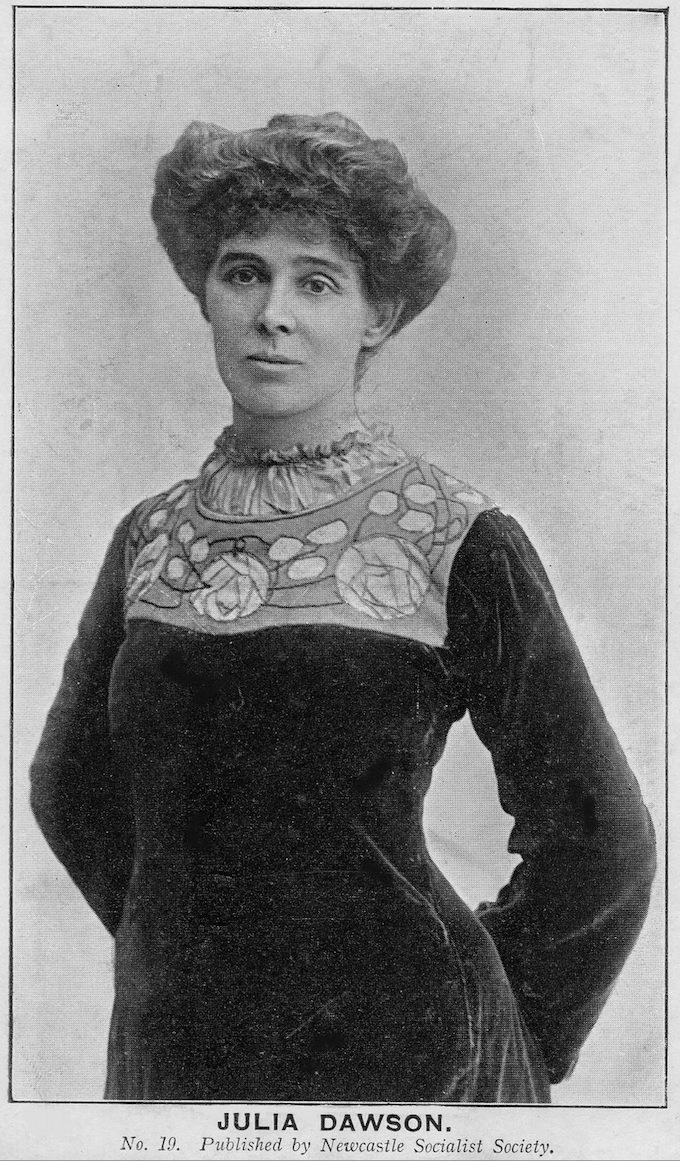
Julia Dawson (Wikipedia)
In 1905 an article in The Art Workers’ Quarterly written by the Secretary of the Liverpool section gave a good description of how the Guild operated:
“The Guild in its organisation differs widely from most similar institutions. It is essentially a workman’s guild. There are no paid officers; even the instructors in the various departments give their services gratuitously, and thus expenses are kept down to the lowest possible level. But the work by no means shows the amateurishness and triviality of the usual “home art worker.” The Guild is intelligently directed, and there is a steadily growing feeling for good sound work, simply designed and thoroughly executed. Branches now exist in London, Liverpool, Manchester, Leeds, Sheffield, Newcastle, Chester, and other centres, and the work of all is brought together at the Annual Exhibition. In addition to the local branches, there is a large number of isolated crafts-folk in various parts of the country who are enrolled as outside or ” unattached ” members, on payment of a nominal subscription.”
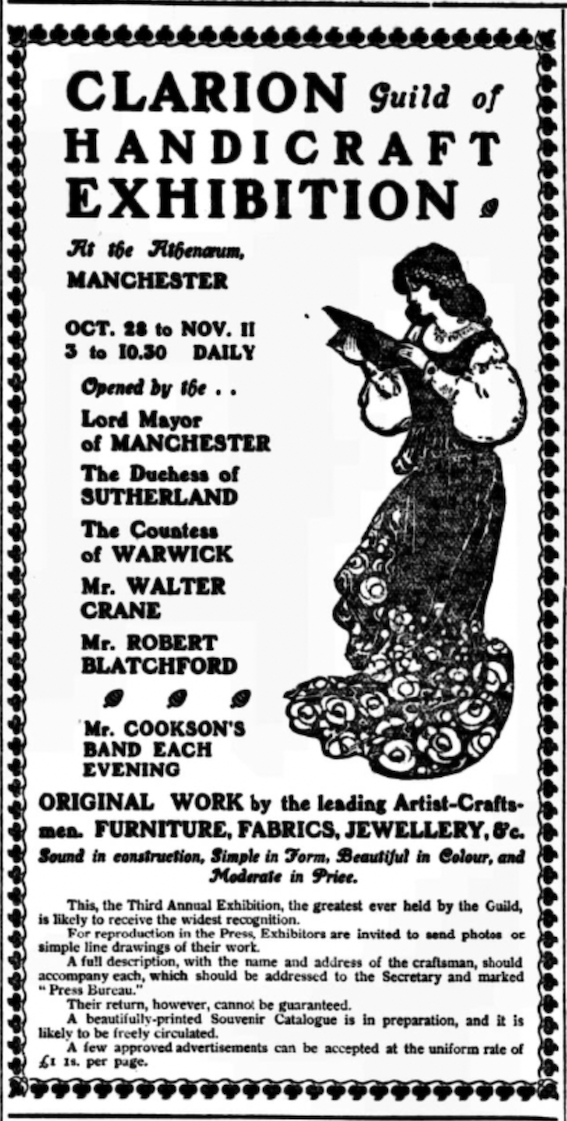
Clarion Advert, Oct 1904.
The 1904 exhibition of Guild work was held at the Athenaeum in Manchester. It definitely shows how far the Guild had come and the people and organisations involved are impressive to say the least. It was opened by the Lord Mayor of Manchester, The Duchess of Sutherland, The Countess of Warwick, Walter Crane and Robert Blatchford. The prizes were awarded by Walter Crane and some very well-known names appear in all of the sections. The wood working section included work by Arthur W. Simpson and Heal & Sons alongside the various local branches of the Guild. The pottery section included work from Ruskin Pottery and Della Robbia Pottery. The metalwork and jewellery section included the work of Hugh Wallis, J. P Steele (to the designs of Barry parker and Raymond and Unwin) and Miss Mary Williams from the London Guild (to the designs by her brother, John Williams). Most importantly for us was the contribution made by the Liverpool Guild. The Clarion newspaper retrospective of the exhibition in December 1904 states:
” A Mr H.M. Worrall of the Liverpool Guild, had a copper plaque of excellent design and workmanship, and two examples, a rose bowl and a vase, beaten up from the flat, of which the latter was particularly pleasing in shape.”
Thankfully we are able to see the items exhibited thanks to an advert in, of all periodicals, the American Craftsman Magazine published by Gustav Stickley!
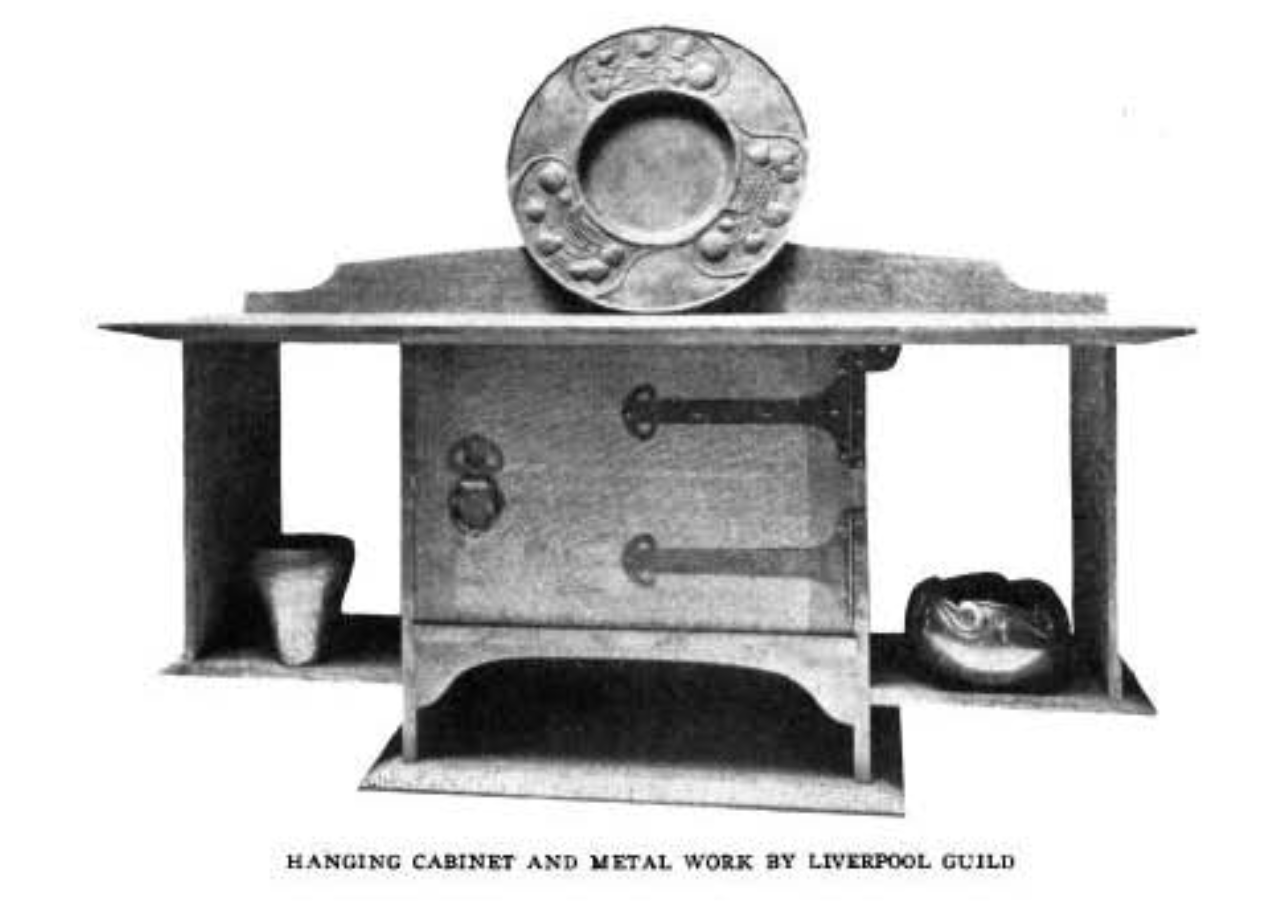
The Craftsman, Volume 8, Issue 2, May 1905, Page 197
The rose bowl is shown on a hanging cabinet also made by the Liverpool Guild. On close inspection I found a signature scratched into the underside of the bowl. It was signed by a H. M. Worrall. At least one newspaper article about the Liverpool Guild mentioned a Harry Worrall and I am quite confident that this was a Harry Myddleton-Worrall, the husband of Julia Myddleton-Worrall also known as Julia Dawson.
It’s always a great feeling when you can give a piece back so much of its history.
Credits/References:
- Clarion (British Newspaper) – Wikipedia
- Julia Dawson – Wikipedia
- Art Workers’ Quarterly, Volume 3, Issue 9, January 1904, Pages 43-46
- Art Workers’ Quarterly, Volume 4, Issue 13, January 1905, Page 33-34
- The Clarion, Dec 16 1904
- The Clarion Dec 23, 1904
- The Craftsman, Volume 8, Issue 2, May 1905, Page 197
- The Clarion, Nov 11, 1904