Arts & Crafts Exhibition Society candlesticks by W. T. Pavitt
The recent discovery of a pair of brass candlesticks has prompted me to write a short article about another Arts and Crafts Movement designer and metalworker who has been largely forgotten over time.
William Thomas Pavitt was born in Langley, Buckinghamshire in 18701. His fathers was the Landlord of the King William IV pub in Langley (Slough). The first mention of Pavitt appears in The Studio in 1896 where he receives an honourable mention in the competition to design a candlestick in bent iron. We also learn that he is living in Lamberth in London.2 By 1901 he has moved to Everton in Liverpool3 where he appears to have been a student at the School of Architecture and Applied Art. In 1901 he is again mentioned in The Studio periodical in an article covering an exhibition of the work of students from the School. We are told that “W. T. Pavitt has worked a gracefully designed copper clock case in beaten copper”.4 In 1902 Pavitt is again praised in The Studio in a review of an exhibition of pictures and applied art by a local group of artists and craftsmen at the studio of Mr H. Bloomfield Bare. Bare himself wrote the review and he states “Good design and craftsmanship were particularly noticeable in the hammered copper work of Alfred Hughes, Will T. Pavitt and Harry Eckstein”.5
Pavitt most likely met Richard Llwellyn Rathbone while studying in Liverpool. Rathbone was teaching metalwork at the Liverpool University between the period of 1898 to 1903. We know that they definitely did meet and started working together in some capacity prior to 1903. Richard Llewellyn Rathbone exhibited a number of items at the 1903 Arts and Carfts Exhibition Society exhibition. A silver-plated jug is noted as designed by Rathbone but made by Will. T Pavitt and Alfred Hughes. Other pieces designed by Rathbone were made by the well-known makers, Harold Satbler and Alfred Hughes.6 It is unclear whether Pavitt was actually working directly for Rathbone in Liverpool at this time or whether there was a loose collaboration between the craftsmen.
Importantly, Pavitt also exhibited a pair of brass candlesticks at the same exhibition. Although he is noted as the designer and maker of the candlesticks, it states that they were exhibited by R. LL. Rathbone & Co, suggesting that Pavitt was indeed working for Rathbone’s company at that time.6 Fortunately, the candlesticks that were exhibited are illustrated in The Art Workers Quarterly in April of 1903.7 The candlesticks are briefly discussed in the same periodical where we learn that “The brass candlesticks, one of which we illustrate on page 70, by W.T. Pavitt, are something similar in idea, but the three strips of brass are slightly curved in section, and taper as they go upwards from the foot.”8 Ironically the same article is less than flattering about the candlesticks exhibited by Rathbone and made by Alfred and Charles Hughes.

Art Workers Quarterly, Volume 2, Issue 6, April 1903, page 70
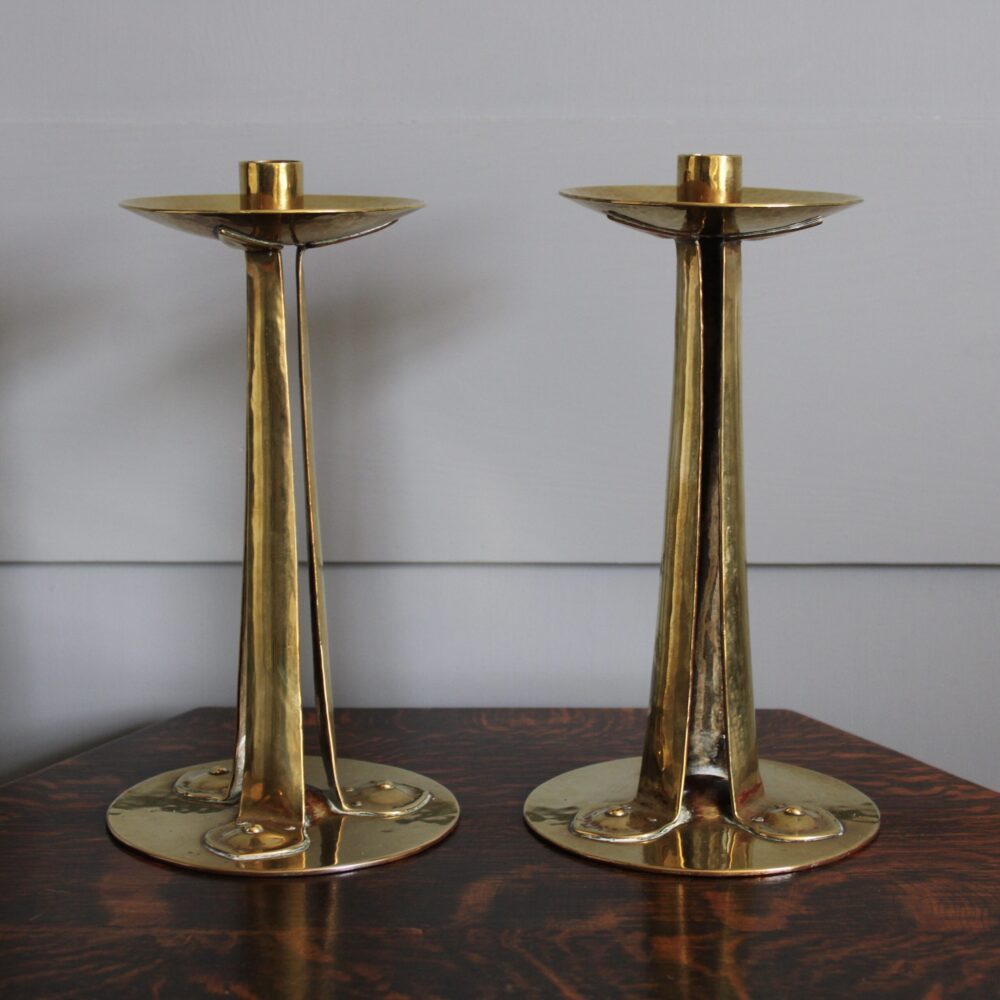
Hammered brass candlesticks by William Thomas Pavitt for Rathbone & Co, circa 1903
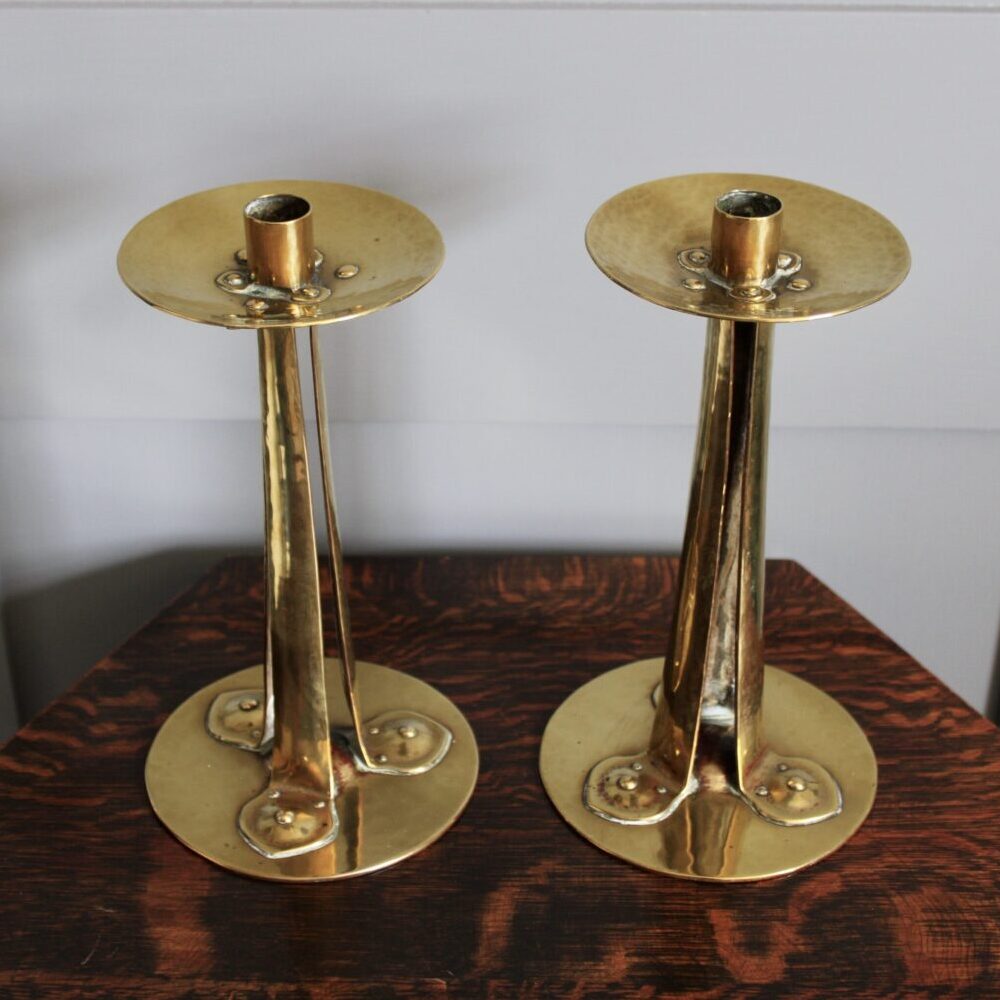
Hammered brass candlesticks by William Thomas Pavitt for Rathbone & Co, circa 1903
The candlesticks themselves are beautifully made from quite a heavy gauge of brass. They are lightly planished all over and the riveted joins are very reminiscent of the other Rathbone designs and of the work of Alfred Hughes. They are also extremely well proportioned and relatively tall at 10 1/2″ in length.
It is possible that Pavitt stayed connected in some way to Rathbone over the next few years. He is mentioned in a 1904 review of the work of Amateurs and Arts Students Exhibition at the Whitechapel Art Gallery where he now seems to be connected to the Arts and Crafts Department of the Sir John Cass Institute in London. He is praised for exhibiting “work that is not common, and speaks very well for their School”.9 It was around this time that Rathbone is thought to have moved to London to take up the post of Head of the Art School of the Sir John Cass Institute.
In 1906 Pavitt marries Kate Pitt, a dress maker and milliner. Although he exhibits a silver cup at the ninth exhibition of the Arts and Carfts Exhibition Society in 191010, he was clearly changing direction and moving more towards designing and making jewellery. His profession is listed in the 1911 census as designer and maker of jewellery.11
Things take an unusual turn here as Pavitt clearly became very interested in talismans, amulets and the signs of the zodiac. Allegedly his wife became a member of the Theosophical Society in 1912 and they jointly published a book called The Book of Talismans, Amulets, and Zodiacal Gems in 1914 (1st edition: William Rider and Son, London, 1914). A number of marked pieces of jewellery by Pavitt have appeared over the years and they generally in the Arts and Crafts style, often mixed with significant symbolism. He appears to have had some success as in 1921 he is still working as a designer of jewellery from 17 Hanover Street in London.12
Very pleased to have found a good reason to write a short article about yet another largely forgotten craftsperson who was heavily involved in the Arts and Crafts Movement in both Liverpool and London.
1 – Census of England and Wales, 1870
2- The Studio, Volume 7, Issue 36, March 1896, Page 121
3 – Census of England and Wales, 1901
4 – The Studio, Volume 23, Issue 102, September 1901, Page 279
5 – The Studio, Volume 24, Issue 106, January 1902, page 287
6 – Arts and Crafts Exhibition Society, Catalogue of the Seventh Exhibition, 1903
7 – Art Workers Quarterly, Volume 2, Issue 6, April 1903, page 70
8 – Art Workers Quarterly, Volume 2, Issue 6, April 1903, page 54
9 – Art Workers Quarterly, Volume 3, Issue 11, July 1904, page 103
10 – Arts and Crafts Exhibition Society, Catalogue of the Ninth Exhibition, 1910
11 – Census of England and Wales, 1911
12 – Census of England and Wales, 1921